
75.22 °F & | Broken clouds
Book A Tee Time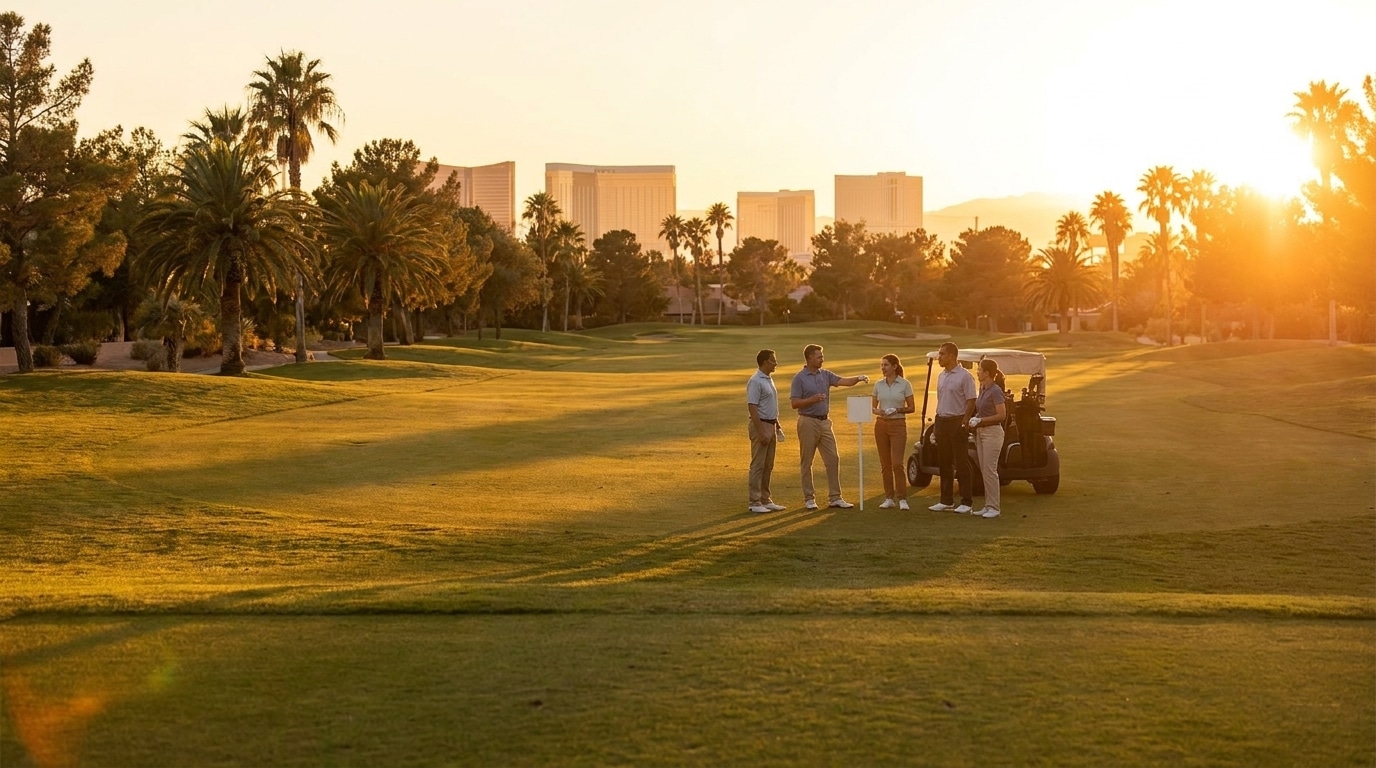
Hosting a corporate golf event in Las Vegas works best when you lock the course and date first, build the itinerary around the city's convention calendar, and treat catering, transport, and permits as three separate workstreams rather than afterthoughts. The destination draws roughly 38.5 million visitors a year and about 6 million convention attendees, so hotel rates, tee sheets, and ground transport move together — book early, write every inclusion into the contract, and plan around the heat.
Target October through April for comfortable outdoor play, and actively avoid the week of any citywide trade show. January averages a high near 59°F and a low near 41°F — golf weather — while summer regularly tops 105°F, which is a real safety issue for players and perishable food alike. Mid-December through early January (excluding CES), July and August, and late May through June are the softer convention windows and typically your best shot at availability.
Las Vegas is a winter-and-shoulder-season outdoor golf destination, and the convention overlap is unforgiving. Those weeks spike hotel rates, strain transport, and compress tee-sheet availability citywide.
Bali Hai Golf Club, the only championship golf course remaining on the Las Vegas Strip, sits directly in that convention gravity — a tropical layout in the shadows of the Strip resorts that groups frequently pair with same-day meetings at the convention corridor. That proximity is a scheduling advantage when your attendees are already on-property for a show, and a reason to lock dates earlier when they aren't.
Book the course well in advance for standard dates, and allow additional lead time if your event touches a major convention week. For events near major trade shows, securing event staff well in advance is advisable, as convention-week demand compresses availability across the city.
Course exclusivity (a shotgun start with the full field, versus a crossover or partial buyout) is the single biggest driver of your lead time. Shotgun starts in prime January–March windows get claimed first, often by returning annual events, so flexibility on day-of-week — mid-week shotguns are easier to secure than weekend-adjacent days — can meaningfully shorten your search.
A corporate quote should itemize green fees, cart, range balls, scoring, food and beverage, service charges, taxes, event staffing, equipment, and transportation — in writing, line by line. Comparing two bids that each quote a "per-golfer rate" is meaningless if one bundles range balls, scoring, and lunch and the other doesn't. Request the same inclusion list from every venue you're evaluating.
For a corporate outing, your checklist should also address:
Build the F&B plan around the temperature. Perishable food left in direct sun at an outdoor Las Vegas event can reach unsafe temperatures within an hour, and summer highs regularly exceed 105°F — so active cooling, shaded service areas, and tight food-safety service windows are non-negotiable from roughly May through September. Food stations and buffets with proper equipment outperform plated service in most outdoor settings.
Menu selection matters as much as logistics. Roasted proteins, grain-based salads, grilled vegetables, and room-temperature appetizers all perform well in Las Vegas heat; delicate dressed greens and seafood on an open halfway-house table do not. Hydration stations on the course — not just at the clubhouse — are standard for any outing between April and October.
Confirm jurisdiction before you confirm anything else. The applicable permit authority depends on whether the event address sits inside the City of Las Vegas, unincorporated Clark County, or another municipality — and the Strip corridor falls outside city limits, in unincorporated county territory. Each has distinct permit, park-use, and alcohol-licensing processes.
Tents, temporary power, amplified sound, road effects, and third-party vendors can each trigger separate reviews, and fire-prevention oversight is a relevant review path for tent structures. Alcohol service at events is regulated locally, not through a general Nevada state event liquor permit — on unincorporated county land, service typically requires a licensed caterer or retailer plus a local permit. Confirm whether your venue's existing licenses cover your event, or whether charity components (raffles, auctions) or outside vendors require additional approvals. Verify every requirement directly with the relevant authority for your specific date and address.
Treat transport as its own line item. Golf courses and event sites are spread across the Las Vegas valley, and travel times vary sharply by time of day and by convention load — a 15-minute hop at 10 a.m. in July can become a 45-minute crawl at 3 p.m. during SEMA. The Strip-adjacent location of Bali Hai Golf Club shortens that equation when attendees are hoteled on or near the Strip, which is the common case for convention-linked groups.
Build arrival buffers into shotgun-start timing (plan on golfers in carts 20 minutes before the horn), stage bag drop at a single curb, and give drivers a named on-site contact. For evening awards back at a hotel or restaurant, confirm return pickup times in writing — ride-share surge during convention weeks is unpredictable.
A clean one-day format runs registration and warm-up for roughly an hour, a shotgun start, several hours of play with on-course F&B and contest holes, and a post-round awards reception. Here is a sample framework you can adapt to your date and group size:
| Element | Typical window | Key planning note |
|---|---|---|
| Bag drop & registration | 75 min pre-shotgun | Single curb, named greeter, pre-printed cart signs |
| Range & putting warm-up | 45–60 min | Confirm range-ball inclusion in contract |
| Shotgun start | Time 0 | Tuesday/Wednesday easiest to secure |
| On-course play | ~4.5 hours | Hydration stations every 3–4 holes in warm months |
| Halfway-house F&B | Mid-round | Stations outperform plated outdoors |
| Awards reception | 60–90 min post-round | Tiki Bar or clubhouse space; confirm alcohol permit coverage |
Score venues on five dimensions, in this order: date availability, proximity to your attendees' hotels, exclusivity options (full shotgun vs. partial), itemized inclusions, and on-site event infrastructure (banquet space, bar, power for sponsor holes, rental equipment depth). Request itemized, date-specific quotes.
October through April offers the most comfortable outdoor conditions, with mild winter highs that make full-day outdoor events manageable. Avoid the weeks of major trade shows — CES in early January and SEMA in the fall — when hotel rates, transport demand, and tee-sheet availability all tighten. Softer windows include mid-December through early January (excluding CES), July and August, and late May through June, though summer heat regularly exceeds 105°F.
Plan on substantial lead time for standard dates and even more when your event falls near CES, SEMA, or another citywide convention. For events near major trade shows such as CES or SEMA, securing staff well in advance is advisable given citywide demand spikes during those weeks. Full-course shotgun buyouts in prime winter windows go first.
Usually yes, and the rules depend on jurisdiction. Alcohol service at events is regulated locally rather than through a general Nevada state event permit. On unincorporated Clark County land, which includes most of the Strip corridor, service typically requires a licensed caterer or retailer plus a local permit. Confirm whether the venue's existing licenses cover your event or whether additional approvals are required.
Per-player cost varies widely by format, exclusivity, date, and inclusions, and there is no single published rate that represents the full market. Request itemized, date-specific quotes that specify green fees, cart, range balls, scoring, food and beverage, service charges, taxes, staffing, equipment, and transportation. Comparing bids is only meaningful when every proposal lists the same inclusions.
Yes, but build transport as its own workstream. Courses are spread across the valley, and travel times shift sharply with time of day and convention load. A Strip-adjacent course shortens transfers for attendees hoteled on or near the Strip — Bali Hai Golf Club sits on South Las Vegas Boulevard directly in that corridor. Confirm return pickups in writing to avoid ride-share surge issues.
Food stations and buffets with proper cooling equipment outperform plated service in most outdoor Las Vegas settings. Choose roasted proteins, grain-based salads, grilled vegetables, and room-temperature appetizers, which hold up well in heat. Keep service windows tight — perishable food in direct sun can reach unsafe temperatures within an hour, and summer highs regularly top 105°F — and add shaded service areas and on-course hydration stations.
A corporate golf event in Las Vegas rewards planners who treat the course, the convention calendar, catering, transport, and permits as five distinct contracts to close — in that order. Get the date and the inclusions in writing, respect the heat, and confirm jurisdiction before you print an invitation. Planners in Las Vegas who want a Strip-adjacent championship venue with corporate outing experience, Callaway rental equipment, caddie and ParMate services, and an on-site Tiki Bar for the awards reception can reach Bali Hai Golf Club at (702) 597-2400 or https://balihaigolfclub.com to request a date-specific quote.

